Strong eval bullets follow a simple formula: result, impact, scope. What you did, what changed because of it, and the scale. “Led a 12-soldier team through a 98 percent equipment readiness inspection” beats “hard worker, great soldier” every single time. Boards read hundreds of these, so quantify everything and tie each bullet to your unit’s mission, not just your effort.
Here’s the thing nobody tells you: your eval bullets are the part of your file that talks when you’re not in the room. At E-7 and above, promotions go through centralized boards that never meet you. They meet your bullets. At E-5 and E-6 you’ll stand in front of a local board yourself, but your NCOER still goes in the packet, and weak bullets follow you up the ladder. Either way, the game is won months before anyone sits down to write.
What is the result-impact-scope formula?
Every strong bullet answers three questions in one line. That’s it. Three.
Result: What did you actually do? Not your job description, the action. “Built a pre-deployment equipment tracking spreadsheet” is a result. “Responsible for equipment” is a duty description wearing a trench coat.
Impact: What changed because of it? This is the part most bullets skip, and it’s the part that gets read first. “Cut turn-in processing time from five days to two” tells the reader why they should care.
Scope: How big was it? Numbers make a bullet real. Twelve soldiers, 40 vehicles, $250,000 in equipment, a battalion of 800. Without scope, your bullet could describe anyone. With it, it describes you.
Result is the action, impact is the why-it-matters, scope is the proof. All three, every bullet, every time.
What do strong bullets look like?
Here’s the difference between a bullet that gets read and one that gets skimmed:
Weak: “Hard worker who always completes tasks on time.” Strong: “Completed 120 work orders with zero delinquencies; shop held a 98 percent on-time rate all year.”
Weak: “Great mentor to junior soldiers.” Strong: “Mentored four junior soldiers through promotion boards; three promoted on first look, fourth earned Soldier of the Quarter.”
Weak: “Excellent physical fitness.” Strong: “Scored 580 of 600 on the fitness test, top 5 percent of the company; ran remedial PT for 15 soldiers and got the company to a 100 percent pass rate.”
See it? The weak ones are adjectives. The strong ones are evidence. Boards have seen “hard charger,” “dedicated,” and “outstanding” about ten thousand times. Those words cost you nothing to write, and they buy you nothing.
Adjectives are claims. Numbers are proof. Write proof.
How many bullets should I write, and how long should they be?
Fewer and sharper beats long and thin. On the Army’s NCOER you’ve got a set number of lines, and every one costs you space. Five bullets they’ll remember beat ten they’ll forget.
One line each. Two max for something genuinely big. If a bullet needs three lines, it’s either two bullets or it isn’t done yet. Start with a strong verb: led, built, trained, reduced, redesigned, recovered. Never start with “responsible for.” That’s your duty description’s job. Your bullets are what you did with it.
What are raters and boards actually looking for?
Three things.
Bullets that earn the box. On the NCOER your rater checks a box: Far Exceeded, Exceeded, Met, or Did Not Meet Standard. Your bullets have to earn whichever box got checked. A Far Exceeded bullet describes results most people don’t get, with numbers to prove it. If every bullet reads like a normal Tuesday, the box reads the same way no matter which one got checked.
A year of evidence, not a memory test. The support form is the legal backbone of your NCOER, and it only works if someone actually filled it in during the year. Raters forget things. The people with great evals aren’t better writers, they’re better note-takers: dates, numbers, outcomes, logged as it happened.
Honesty. Boards read thousands of bullets. They can smell a recycled bullet library from a mile away. Your numbers, your unit, your mission, that’s what stands out. Borrowed bullets all sound the same because they are the same.
One cross-branch note: the forms are different (NCOERs for Army, EPRs for Air Force, FITREPs and evals for Navy and Marines) but the writing rule doesn’t change. Result, impact, scope works everywhere. Your branch’s official regulation has the form-specific rules, linked below.
Do bullets matter outside the military?
Absolutely. Civilians don’t call them bullets, but it’s the same skill behind every good self-evaluation, performance review, and resume you’ll ever write.
Most civilian jobs make you evaluate yourself at review time: what did you accomplish, what changed because of it, how do you know? That’s result, impact, scope under a different name. The people who can quantify their work (“grew revenue 18 percent,” “cut onboarding time from three weeks to five days”) get the raises and the promotions. The people who write “hard worker, team player” get overlooked.
So every bullet you write now is reps for the career after the uniform. Learn to prove your value on paper here, and you carry that skill everywhere you go.
Where EVENTUALLY.VET fits
The hardest part of eval season isn’t the writing. It’s remembering. Twelve months of accomplishments, squeezed into a support form from memory, is how great work vanishes.
That’s why your finished evals belong in the app too, not just the official system. When a board convenes or a new rater wants your history, you should be able to pull up every eval from your phone in seconds. Systems go down, access gets weird after a PCS, and paper copies disappear into the void. The copy on your device doesn’t.
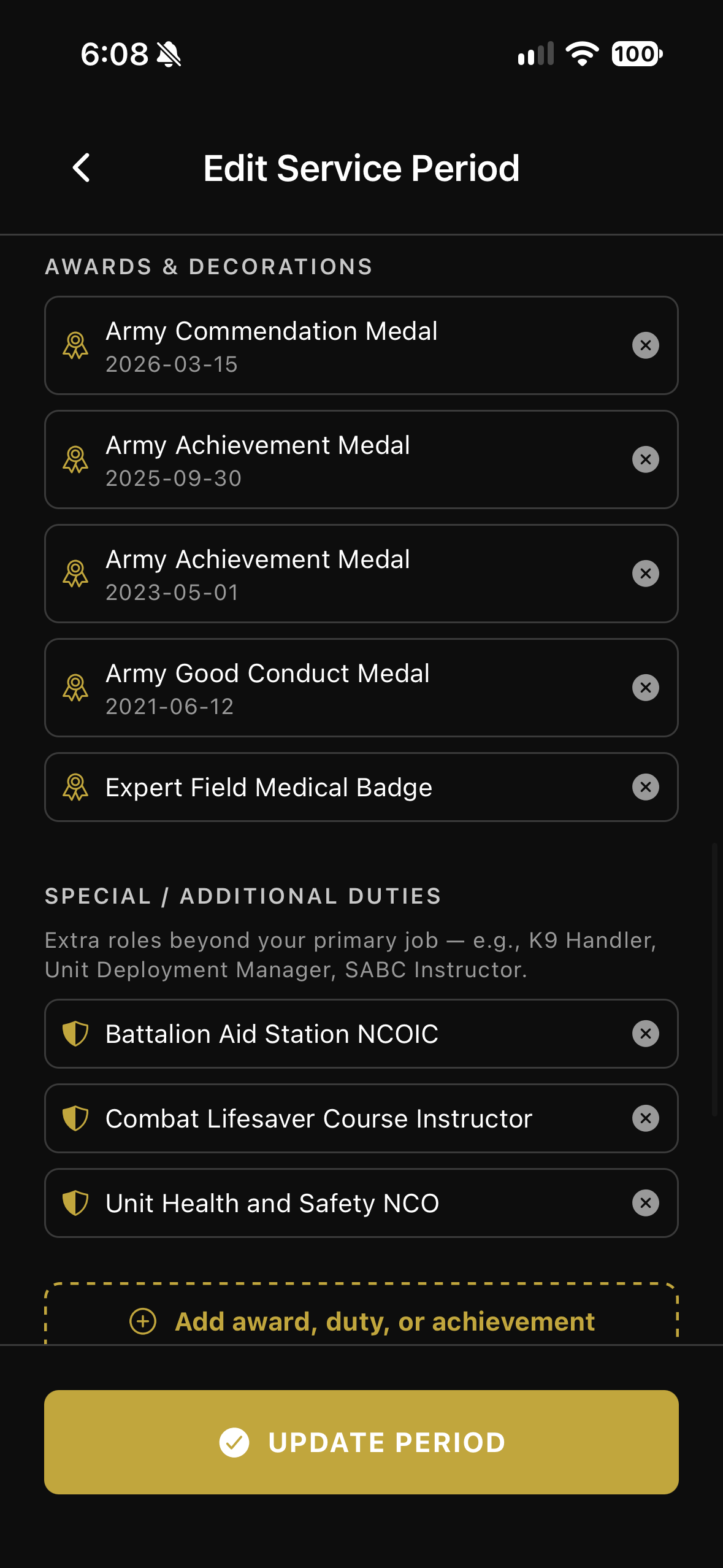
EVENTUALLY.VET keeps an accomplishment log on your phone: the awards, the training completions, the numbers you’d otherwise be scrambling to remember in October. Log it the week it happens, and when eval season rolls around, your support form practically writes itself. That’s the whole idea behind Friday’s Short, “Never Scramble for Your Eval Again.” The habit is the app.
Free on the App Store for iPhone. Android is coming soon, join the waitlist at EVENTUALLY.VET.
Where to go from here
- Army Publishing Directorate (AR 623-3 and DA PAM 623-3, the NCOER rules): https://www.armypubs.army.mil
- Air Force Personnel Center evaluations resources: https://www.afpc.af.mil/Career-Management/Evaluations/
- Watch the Short: “Never Scramble for Your Eval Again” (publishes Nov 6, 5pm ET)
Your eval gets written all year, not in October. Keep the log, put numbers on everything, and give them bullets worth remembering.
EVENTUALLY.VET is not affiliated with, endorsed by, or connected to the U.S. Department of Veterans Affairs, the Department of Defense, or any branch of the U.S. military.