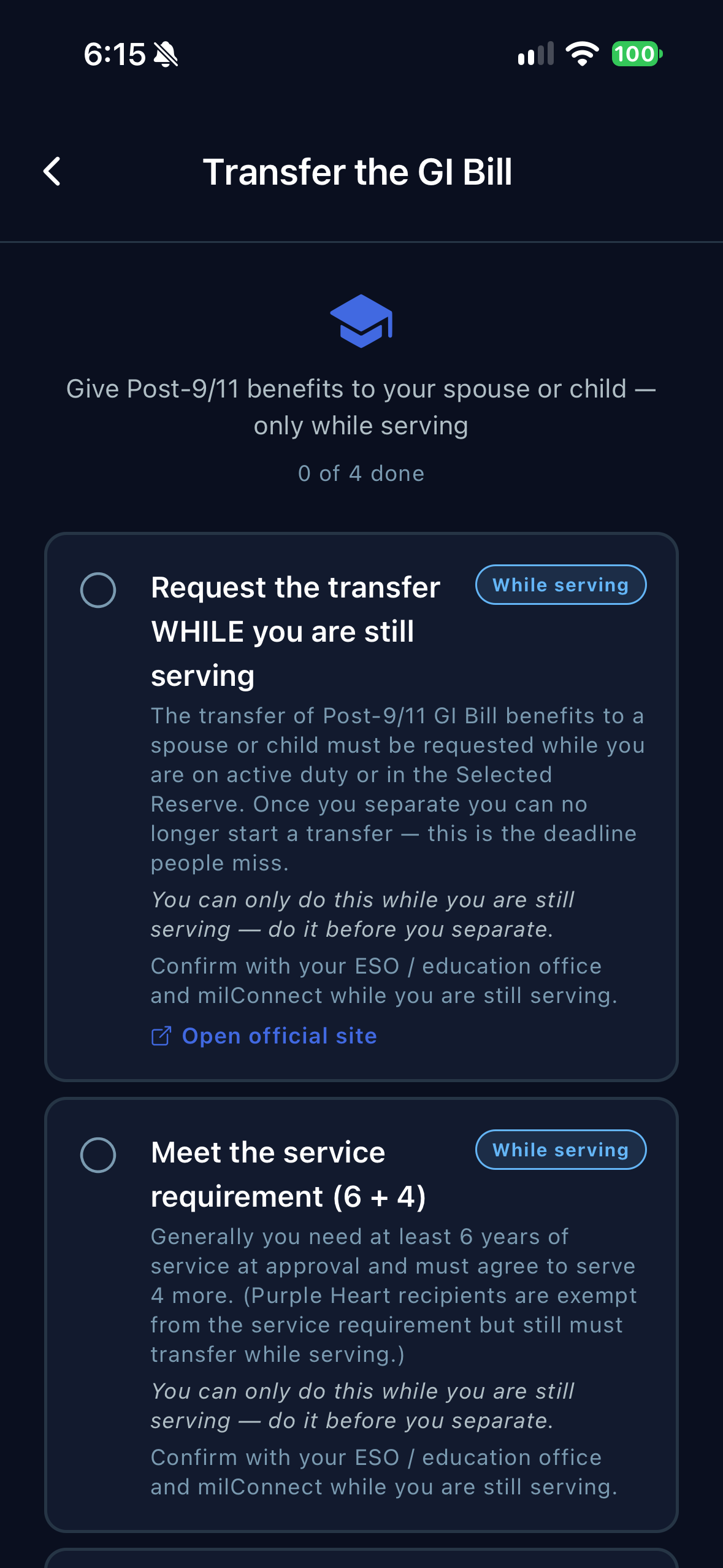
You can transfer your Post-9/11 GI Bill benefits to a spouse or children if you have at least six years of service and agree to serve four more, with some exceptions. Request the transfer through milConnect’s Transfer of Education Benefits portal while you are still serving, because you generally cannot start a transfer after you separate or retire.
I know how easy it is to miss this window because it happened in my own house. My husband never transferred his GI Bill, even though transfers have been possible since 2009. He was ready to retire and had no idea the transfer came with an additional four-year service obligation, so it wasn’t possible for him. We didn’t have kids until after he retired anyway, so by the time our son arrived, the door was shut for good. Nobody sat us down and explained the timing. That’s exactly why I’m writing this article.
Most people hear “GI Bill” and think college tuition. And when military families talk about it, the transfer piece usually comes up fast: you can pass those education benefits to your spouse or kids.
But there’s a lot more to it than just signing a form. There are rules about when you can transfer, how you can split it up, when your family can actually use it, and what happens to the months nobody touches. Plus a bunch of ways to use it that have nothing to do with a four-year degree: trade schools, certifications, apprenticeships, flight training.
The worst time to learn all this is while you’re out-processing. By then, some doors are already shut.
So here are 12 things every service member and military family should know.
1. Can I transfer my GI Bill after I separate from the military?
This is the big one, so let’s lead with it.
If you want to transfer your Post-9/11 GI Bill to your spouse or kids, you generally have to start the process while you’re still serving, active duty or Selected Reserve.
Once you’re out, you’re out. No new transfers after separation or retirement.
Read that again, because this is where people get hurt: you can do 20 years, retire with full honors, and still lose the ability to pass this benefit to your family if you never filed the transfer while you were eligible.
Don’t wait until you’re signing retirement paperwork. Start early, and confirm the transfer actually got approved.
2. Does transferring my GI Bill require an additional service commitment?
Yep, usually. This surprises a lot of people.
The general rule: at least six years of service, plus an agreement to serve four more, and then you can transfer.
There are exceptions. Purple Heart recipients, for example, skip the service-time requirement but still have to file while on active duty. Retirement-eligible folks have their own special rules.
If you’re anywhere near retirement, don’t guess on this one. Talk to your education office or personnel office and get your specific obligation in writing before you file.
3. Can I split my GI Bill between multiple family members?
You don’t have to hand the whole thing to one kid.
The Post-9/11 GI Bill gives you up to 36 months of entitlement, and you can slice those months across your eligible dependents however you want. Twelve months each for three kids. Some for your spouse, the rest for the kids. Your call.
The catch people miss: it’s 36 months total, shared. You don’t get 36 months per person.
So think about the long game before you carve it up. Who’s most likely to use it, and when?
4. Can I transfer benefits to my children before they’re college age?
You don’t have to wait until anyone’s touring campuses.
Kids can be designated young, as long as you meet the transfer requirements and they’re enrolled in DEERS. Honestly, earlier is better. The families who get burned are the ones who kept meaning to do it and then hit retirement without ever filing.
Don’t wait until your kids are teenagers. Handle it while you’re still eligible.
5. When can my spouse and children start using transferred benefits?
Transfer approved doesn’t mean everyone can start spending it tomorrow.
A spouse can generally start once the transfer is approved and the eligibility boxes are checked.
Kids have to wait longer: generally until you’ve hit 10 years of service, and the child is 18 or a high school graduate. And they usually have to use it before turning 26.
Plan around the actual timelines, not the assumption that transferred means ready to use.
6. Can I take back unused GI Bill months and give them to someone else?
Life happens. You give 12 months to one kid, and then they land a full scholarship or decide college isn’t for them.
Good news: you can generally revoke unused months and reallocate them, to another dependent or back to yourself, through milConnect.
So if you split things three ways and one kid goes the trade school route on a different dime, you’re not stuck. Review your allocations every few years and adjust.
7. Can my spouse use the GI Bill while I’m still serving?
They don’t have to wait until you retire. But there’s a wrinkle worth knowing.
A spouse using transferred benefits while you’re still on active duty generally can’t collect the monthly housing allowance. Kids play by different rules and may qualify for it even while you’re serving.
That housing money is significant, so factor it into your timing. Sometimes waiting until after separation puts more total dollars in your family’s pocket.
8. Do transferred GI Bill benefits expire?
Here’s one a lot of spouses don’t know.
If your qualifying separation was on or after January 1, 2013, transferred benefits generally don’t expire for your spouse. Before that date, there’s generally a 15-year clock.
Kids are different: they generally have to use it before age 26.
This matters because your spouse might not want to start school right away. Maybe they’re waiting until the kids are older or life calms down. Knowing whether there’s a clock running changes the whole plan.
9. What can the GI Bill pay for besides a traditional college degree?
Not every kid wants a four-year university, and that’s fine, because the GI Bill isn’t just for bachelor’s degrees.
Depending on the program, it can cover trade and technical schools, HVAC training, truck driving programs, EMT training, flight training, apprenticeships, on-the-job training, licensing and certification exams, and grad school.
If your family’s plans lean toward a trade or a specialized career, don’t write off the GI Bill. Check what’s approved first.
10. What is the Yellow Ribbon Program?
If anyone in your family has eyes on a pricey school, read this one twice.
For students at the 100% benefit level, the Yellow Ribbon Program lets participating schools chip in toward tuition above the standard GI Bill limits, and the VA matches it.
This is how families make private universities, out-of-state schools, and grad programs work. Transferred-benefit spouses and kids can qualify too.
Before you cross an expensive school off the list, check whether it’s in the program.
11. Is there extra GI Bill money for STEM degrees?
There can be. The Edith Nourse Rogers STEM Scholarship offers up to nine extra months or $30,000, whichever comes first, for eligible STEM students running low on entitlement.
Two catches: there are specific degree and eligibility requirements, and this one can’t be transferred to anyone else. It’s for the student who earned it.
If you’re in a qualifying STEM program and watching your months run out, look into this before you assume you’re done.
12. Can the GI Bill pay for professional licensing and certification exams?
Yep, and this one flies under the radar.
Beyond tuition, the GI Bill can cover approved licensing and certification tests: IT certs, professional licenses, skilled trade certifications, industry credentials.
If someone in your family wants to level up their career without enrolling in a degree program, this is real money sitting on the table. Don’t pay out of pocket for an exam the GI Bill would’ve covered.
Five things to do about your GI Bill before you retire
If you take one thing from this article, let it be this: the GI Bill needs your attention years before retirement, not weeks.
- Verify you’re eligible to transfer. Don’t assume.
- File the transfer while you’re eligible. Don’t wait for the retirement checklist.
- Review your allocations. Make sure the months are pointed at the right people.
- Learn the expiration and housing rules. They change the math on timing.
- Look past the four-year degree. Trades, certs, apprenticeships, flight school, it’s all on the table.
Where to manage and research your GI Bill
Official resources, bookmark them:
- milConnect: https://milconnect.dmdc.osd.mil/milconnect/ — file and manage your transfer.
- VA Transferred Benefits: https://www.va.gov/family-and-caregiver-benefits/education-and-careers/transferred-gi-bill-benefits/ — the rules for spouses and kids.
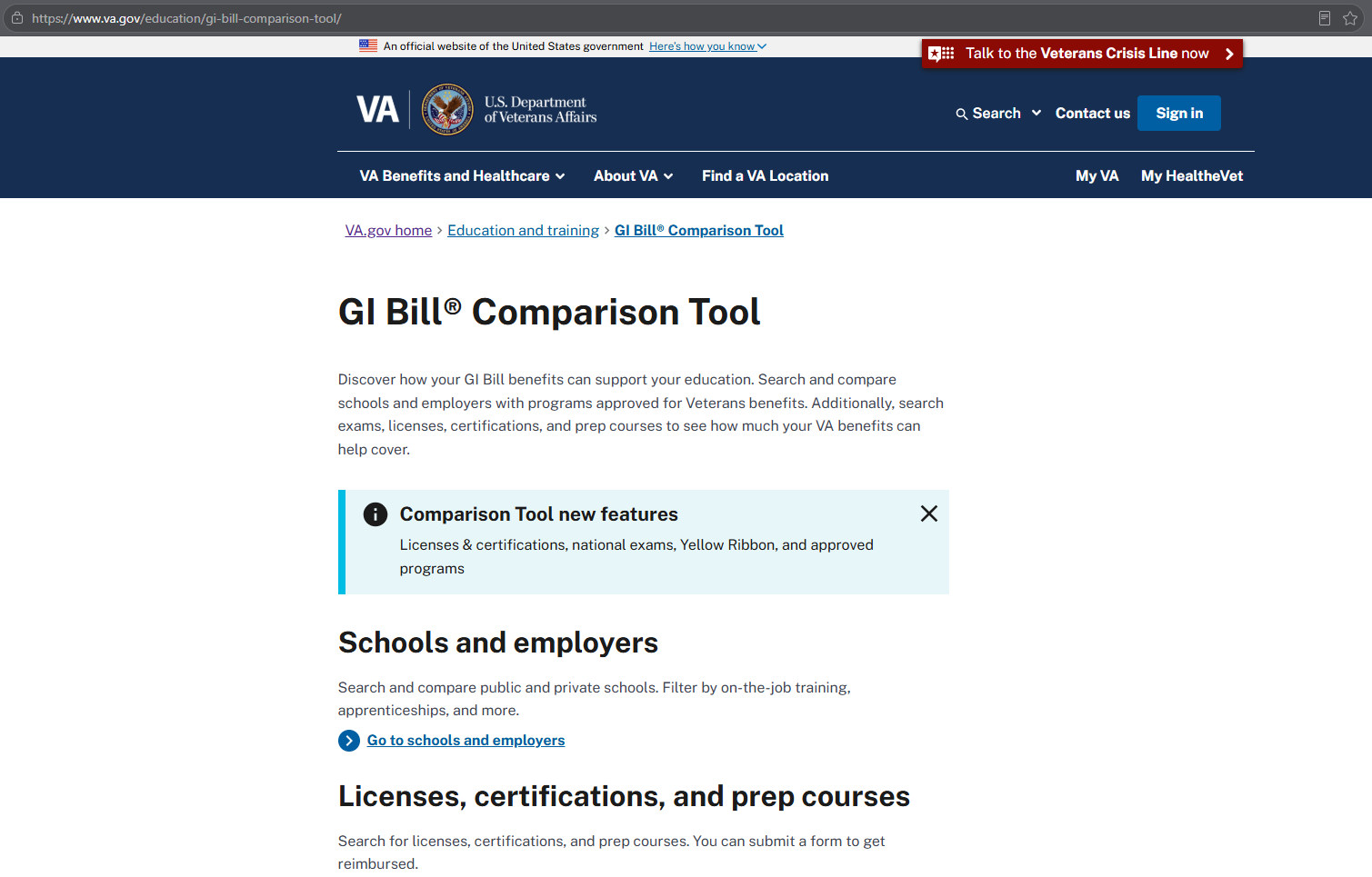
- GI Bill Comparison Tool: https://www.va.gov/education/gi-bill-comparison-tool/ — compare schools and programs.
- Yellow Ribbon Program: https://www.va.gov/education/about-gi-bill-benefits/post-9-11/yellow-ribbon-program/ — find participating schools.
Always confirm your own eligibility and obligations with your education office and the VA. Your eligibility runs on your record being right. Here’s how to check your OMPF for missing awards and wrong dates. The details depend on your service history and separation date.
Keep your family’s benefits on track
A GI Bill transfer runs on deadlines, and deadlines are easy to miss mid-career. EVENTUALLY.VET tracks the time-sensitive stuff that protects your family’s benefits: GI Bill transfer timing, SGLI beneficiary reviews, DEERS updates, with date-aware guidance for each.
Your service records are yours. EVENTUALLY.VET keeps your orders, medical records, evals, and deployment documents in one place on your own phone. Free on the App Store for iPhone. Android is coming soon, join the waitlist at EVENTUALLY.VET.
Final thoughts: don’t leave your GI Bill benefits on the table
Military families give up a lot during a career. The GI Bill is one of the benefits that keeps giving long after the uniform comes off.
But having the benefit and knowing how to use it are two different things.
Don’t wait until your kid’s a high school senior or you’re clearing post to learn the rules. Understand the benefit. File the transfer while you can. Check your allocations. Make sure your family knows what’s there.
You earned this. Make sure your family actually gets to use it.
EVENTUALLY.VET is not affiliated with, endorsed by, or connected to the U.S. Department of Veterans Affairs, the Department of Defense, or any branch of the U.S. military.